QILaplace
QILaplace.jl is a Julia library for quantum-inspired signal transforms on classical hardware. It combines Matrix Product State (MPS) data representations with Matrix Product Operator (MPO) circuit compression to evaluate Fourier- and Laplace-type transforms at scales where dense methods become impractical. Instead of materializing full vectors or matrices, QILaplace works directly with compressed tensor networks, so the workflow stays memory-efficient and controllable through truncation tolerance and bond dimension.
The package currently provides three transform families in one consistent API: a Quantum Fourier Transform, a real-axis Laplace (damping) transform, and a full complex discrete Laplace (z-transform). Around these, it includes signal conversion to MPS using SVD and randomized SVD support for scalable preprocessing.
Installation
You can install QILaplace by running the following command in the Julia REPL:
using Pkg;Pkg.add("QILaplace");If you are more of an interactive coder, you can run the same by going to the pkg mode:
] add QILaplaceThis package is built on ITensors.jl, which requires Julia 1.10 or above for a stable performance. So it is recommended to have Julia 1.10+
Easy navigation around the docs:
- Core Concepts: learn the tensor-network ideas behind the package.
- Signal Tutorial: start with signal encoding and compression.
- DFT Tutorial: see the QFT-style Fourier workflow.
- DT Tutorial: understand the damping transform.
- zT Tutorial: follow the full discrete Laplace / z-transform workflow.
- Benchmarking: inspect runtime and scaling behavior.
- API Reference: browse the public interface.
Further Learning
If you are interested in the concept/theory of laplace, and fourier transforms, feel free to check out these videos by Grant Sanderson (3B1B).

3Blue1Brown: A visual introduction to Fourier transforms.
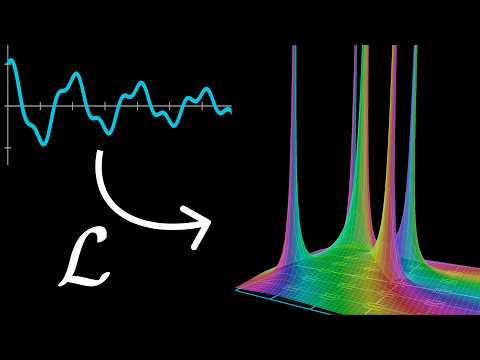
3Blue1Brown: Visual intuition for Laplace-transform ideas.
Check out some more literature and lecture materials on tensor networks
- TensorNetwork.org for a solid introduction to MPS, MPOs, and tensor-network methods.
- Tensors.net for hands-on tensor-network numerics (contractions, SVD/QR, gauges, canonical forms) with code-first explanations.
- Lecture by Schollwock for an accessible introductory video set on core MPS ideas and practical DMRG workflow (useful to understand the concept of orthogonality center used in our algorithms).
- Lecture notes on quantum-inspired tensor network computational techniques for a neat intro to MPS/MPO algorithms in solving, under the quantics representation, partial differential equations, integration, transforms (such as the Quantum Fourier Transform to solve heat equation), and many more.